
Explorative or confirmation research question? How you can develop them from this research design
You have a research question but are you unsure whether you should proceed qualitatively or quantitatively? Do you need hypotheses or are allowed to ask open questions? Then you probably lack methodological knowledge. Then you don’t have a look at the level of knowledge of your field.
In this post I show you a simple way of thinking that I constantly use seminars and consultations — And this helps you to ask the right kind of research question and at the same time avoid typical mistakes that I still see regularly after more than 1,000 supervised work.
The research life cycle: How knowledge about a concept is growing
Every scientific concept – whether autism, teacher support, resilience or whatever concerns you – follows a halfway predictable development. I call this the research lifecycle and it looks like an S curve.
In the beginning there is zero knowledge. Someone observes a phenomenon, gives it a name, and the scientific discourse begins. This phase is about the basics: What does this term mean? How can he be defined? What are the subdimensions? What are related concepts? With every question answered, knowledge grows — first slowly, then ever faster.
At some point the desire to make the whole thing more tangible arises. Someone develops a diagnostic tool, a questionnaire, an observation scale. And with that new doors open: suddenly you can measure, compare, test. Knowledge continues to grow, but the questions are getting smaller and more specific. At some point the curve flattens out — not because the topic becomes unimportant, but because the big questions have been answered.
This S curve is not an abstract model. It is a practical tool to understand what kind of question you can ask — and which ones not.
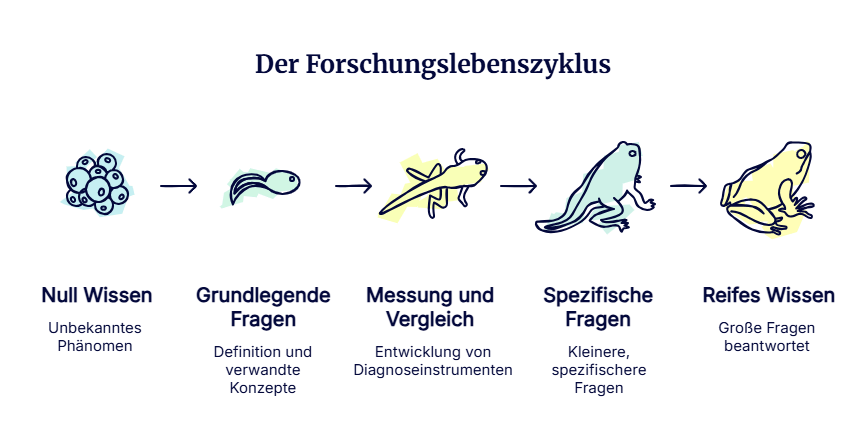
Two types of research questions
The crucial point on the S-curve is the middle — the turning point. Before and after, various questions are asked.
At the bottom of the curve there are exploratory questions. The field is still young here. We want to discover, understand, map something new. The questions are open: How is something defined? What do those affected experience? Which patterns can be identified? The methods for this are mostly of a qualitative nature — interviews, focus groups, ethnographies, photo voice. It’s about collecting material for interpretation, not about given answer boxes.
Confirmational questions are in the upper area of the curve. We already know a lot here. We have theories, models, measuring instruments. And on this basis we test specifically: X really affects Y? Is the effect also detectable in a different context? This is where hypotheses come into play, standardized instruments and quantitative methods.
Of course, the border is fluid — there is no hard cut between explorative and confirmation. But the distinction is still fundamental because it determines what you can do methodically at all.
Good to know: Exploratory and confirmation questions are not quality judgments. An exploratory question is not ‘worse’ than a confirmation. It only fits to a different level of knowledge in the field. The question is not what sounds better – but what fits the current state of research.
The two classic mistakes
As simple as this model sounds — I constantly see the mistakes that arise from it in student work. And it’s always the same two.
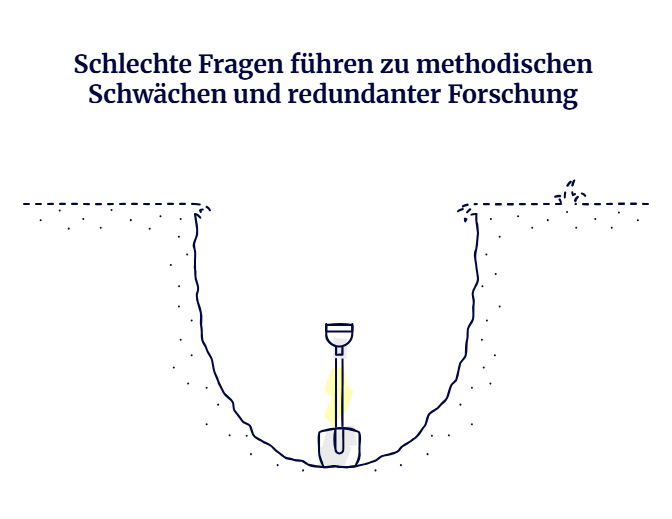
Error 1: Ask a confirmation question, although the prerequisites are missing. This happens particularly often when students feel obliged to work quantitatively. They formulate a hypothesis – X influenced Y – but have neither a measuring instrument for X nor one for Y, and the theoretical basis for the hypothesis is thin. Nevertheless, a questionnaire is made and sent out. The result is almost always a work that stands methodically on shaky legs.
And so that this is clear: developing a measuring instrument on the side is not a solution. A validation process is a dissertation for a complex construct. With a simple construct, maybe a master’s thesis. But it’s never something you do ‘additionally’.
Error 2: Ask an exploratory question, although the field is already well developed. This is the classic Reinventing The Wheel. The question sounds new, but if you know the literature, you actually already know the answer. The argument for the news is usually flimsy: ‘Yes, but this has not yet been examined for this special type of school.’ That alone is not enough. If the only difference to existing research is a marginal context difference, the real research gap is missing.
Our tip: Before you set your research question, ask yourself a simple counter-question: Where on the S-curve is my concept? Are there measuring instruments? Are there established theories? Are there meta-analyses? Depending on how you answer these questions, you know whether your question should be exploratory or confirmation — and thus save yourself the most common design error in student work.
What this means for your choice of method
The S-curve not only gives you the question type — it also gives you a methodical corridor.
In the exploratory area you typically work with qualitative methods. You conduct expert interviews because practitioners have knowledge that is not even discussed in the literature. You organize focus groups to capture different perspectives. You go where knowledge already exists — namely in practice — and systematically bring it into science.
In the confirmation area, you use the economic advantage of existing instruments. Someone else has already invested years to develop and validate a questionnaire. You can adopt it, customize it for your context and work with it. You don’t start from scratch, but build on a solid basis. And you benefit from the fact that quantitative methods are scalable — you can work with significantly larger samples than in the qualitative area.
However, the price for this is that you have to meet the requirements. No instrument, no confirmation study. It’s that simple. In the exploratory area, you have more methodical freedom, but less opportunity to generalize broadly. You can work broadly in the confirmation area, but only if the infrastructure is there.
Not a suitable measuring instrument? then search in concentric circles
Let’s say you want to work quantitatively, but you can’t find an instrument that fits your construct exactly. This is annoying, but no reason to give up immediately.
Imagine your core construct as a point in the middle. There are concentric circles around — related concepts that are less and less similar to your core, but for which there may already be instruments.
An example: You want to measure support from specialist teachers for autistic children. In the innermost circle you are looking for exactly this instrument – and find nothing. In the next circle you look for instruments for support from support teachers. then for support from teachers in general. then for support services by psychosocial professionals. The further away from the core, the more likely you will find something — But the more you have to argue theoretically why this instrument is transferable to your context.
If you can justify cleanly that an instrument from the second or third circle is also valid for your context — then you can work with it. If not, then not. And then the honest answer might be: your concept is not yet ready for a confirmation study, and you should think about an exploratory approach.
What to do with it
The decision between exploratory and confirmation research is No question of taste. It depends on how much your field already knows about your concept. And you can work out this assessment by asking yourself three questions: Are there established definitions and theories? Are there validated measuring instruments? And is there enough empirical basis for a hypothesis?
If so, you are in the confirmation area — and you can build on existing instruments and theories. If not, you are in the exploratory area – and that’s just as legitimate, as long as you implement it methodically.
The most common error is not the wrong method. The most common mistake is a question that does not match the knowledge of the field. And you can now avoid this mistake.