
PhD Funding: Why the Money Is Not the Most Valuable Part
Most PhD candidates think about funding in one dimension: financial support that makes the dissertation possible.
That framing is understandable. Tuition, living costs, research expenses — these are real and pressing concerns.
But it misses what PhD funding actually does for your academic career.
The money is useful. The network it builds is transformative.
In this post, I want to make the case for approaching PhD funding as a strategic tool — one that strengthens your dissertation and your academic career, regardless of whether the application succeeds.
What PhD Funding Actually Gives You
When you apply for research funding as a PhD candidate, something important happens before any decision is made.
You are forced to articulate your research clearly enough that serious stakeholders are willing to attach their name to it.
That buy-in is worth more than the funding itself.
The consortium partners, collaborators, and institutions who agree to join your proposal have a vested interest in your research succeeding.
They bring expertise, data access, and credibility.
And crucially — they remain part of your network whether the funding comes through or not.
The Strategic Value of a Research Network
A mid-scale or large-scale research project creates something that a solo dissertation rarely does: a structured network of people with a shared investment in your work.
These are not passive contacts. They are active collaborators who have agreed, in writing, to work with you.
They will contribute to data collection. They will co-author publications. They will open doors to institutions and communities that would otherwise take years to access.
An academic network built through a funding proposal is one of the strongest career assets a PhD candidate can develop.
And it costs far less than you might expect — because consortium partners participate precisely because they benefit too.
PhD Scholarships and Grants: The Competence You Build Along the Way
There is another layer to this that rarely gets discussed openly.
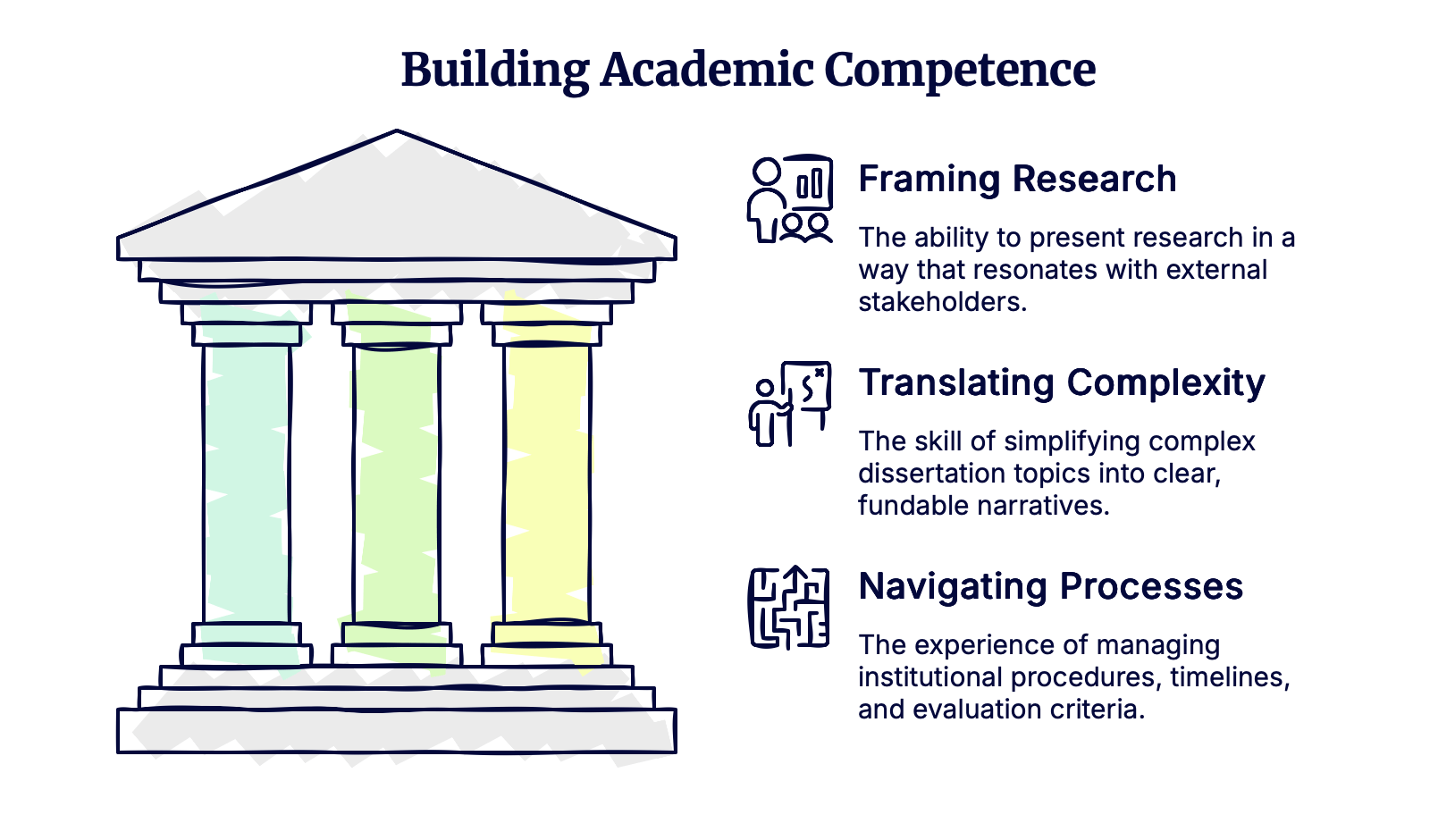
Writing a serious funding proposal — whether for a PhD scholarship, an academic grant, or a larger research project — builds a specific set of competencies.
The ability to frame research for external stakeholders.
The discipline to translate a complex dissertation topic into a compelling, fundable narrative. The experience of navigating institutional processes, timelines, and evaluation criteria.
These are skills that distinguish competitive academic candidates.
In many cases, the credential of having successfully secured research funding is more valuable on the academic job market than the PhD itself.
What Rejection Actually Means
A denied funding application is not a closed door.
In practice, rejected proposals are often resubmitted — sometimes one semester later, sometimes in a revised form, sometimes through a different funding stream.
The proposal you write today becomes the foundation for the application that succeeds tomorrow.
I have seen this pattern repeatedly. In one significant project, we did not succeed on the first attempt.
We are currently resubmitting a stronger, more developed version and I am confident the outcome will be different.
None of that work was wasted. Every iteration sharpened the research design, deepened the network, and clarified the argument.
PhD Funding and Dissertation Quality
There is a direct line between research funding and dissertation quality that is easy to overlook.
A funded project — or even a seriously proposed one — typically involves multiple data collection points across different contexts.
This creates opportunities for international comparison, triangulation, and the kind of methodological richness that strengthens a dissertation significantly.
More data points mean more resilience. If one collection effort encounters problems, others remain.
If your project spans multiple countries or languages, you gain comparative depth that a single-site study cannot offer.
The dissertation that emerges from a well-constructed funding proposal is almost always stronger than one developed in isolation.
The Real Reason to Pursue PhD Funding
Let me distill this into something concrete.
The reason to pursue PhD funding is not primarily about securing a salary or covering research costs — though both matter.
The reason is what the funding process forces you to build.
A network of stakeholders who believe in your work. A clearly articulated research design that has been tested against external scrutiny. A set of collaborative relationships that will outlast the project itself.
Whether the funding comes through or not, those assets belong to you.
That is the case for approaching every serious PhD funding opportunity not as a gamble, but as a strategic investment in your research and your career.
Good luck!