
Academic Job Market: Why the Numbers Don’t Tell Your Story
Every few months, a new wave of anxiety sweeps through academic social media.
The numbers are bleak, the posts say. Too many PhDs. Too few positions. The academic job market is broken.
It is understandable that these narratives cause concern. Years of training, significant personal investment, and genuine uncertainty about the future — that combination makes any alarming statistic feel personally relevant.
But in my experience, those statistics are almost always the wrong thing to be looking at.
In this post, I want to explain why the commonly cited numbers on PhD overproduction are misleading, why the academic job market is far more navigable than it appears, and what actually determines success in it.
Why the PhD Overproduction Numbers Are Misleading
The headline figures are familiar: vastly more PhDs are trained each year than there are permanent academic positions available.
That sounds alarming. But the numbers do not tell the whole story.
A significant fraction of PhD candidates — in many fields, the majority — never intended to pursue an academic career in the first place.
Many enter doctoral programs to advance in industry. Others use the PhD as a credential for non-academic roles. Some pursue it out of intellectual curiosity, with no intention of competing for a university position.
The pool of PhD candidates is inflated. And when you remove those who were never competing for academic positions, the picture changes substantially.
The Definition Problem: What Counts as an Academic Position?
The other side of the equation is equally distorted.
Most statistics on academic job market scarcity refer exclusively to positions within the classical university system — tenured or tenure-track roles at research institutions in a given country.
That is an arbitrary and limiting definition.
Many people build genuine and sustainable academic careers outside that narrow category.
Researchers employed by think tanks, independent research institutes, international organisations, and government bodies. Academics who hold positions across multiple institutions or countries. Those who combine research with other professional roles.
When you broaden the definition of what counts as an academic career, the number of available positions increases considerably.
The Academic Job Market Is Fragmented and That Works in Your Favour
Here is the part that most anxious social media posts miss entirely.
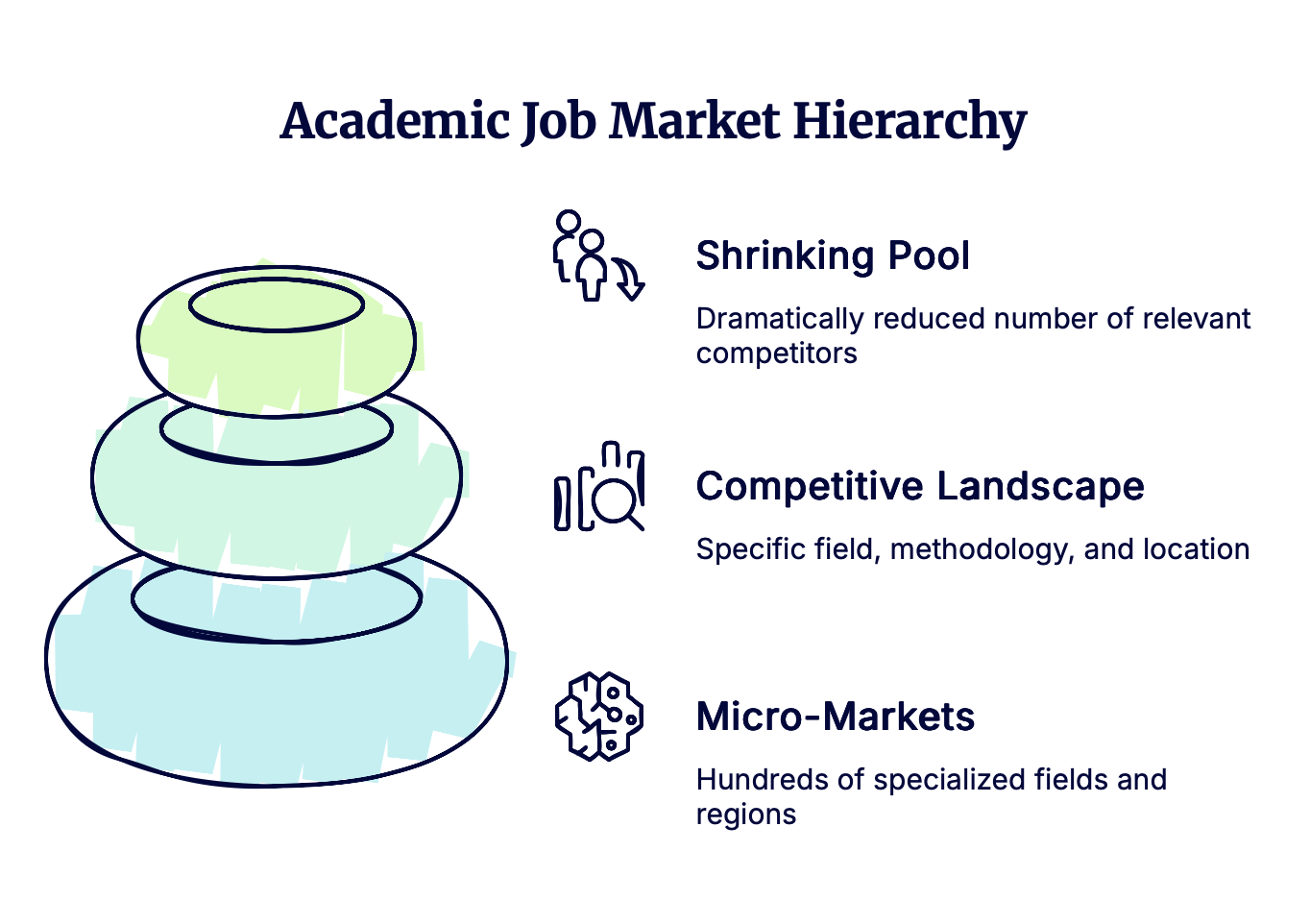
The academic job market is not one market. It is hundreds of micro-markets, defined by field, subfield, region, language, institutional type, and research focus.
A medievalist in Germany is not competing with a computational biologist in Singapore. A researcher in educational psychology is not in direct competition with someone working in economic history.
When you map your actual competitive landscape — your specific field, your methodological profile, your geographic flexibility, your language competencies — the relevant pool of competitors shrinks dramatically.
For most PhD candidates, the realistic competition for any given position is a fraction of what the aggregate statistics suggest.
This does not make the process easy. But it makes it fundamentally different from the picture that overproduction narratives paint.
It Is Not About Competence — It Is About Fit
This is perhaps the most important reframing I can offer.
Academic hiring is not primarily a competence ranking. It is not a process in which the most qualified candidate reliably wins.
It is a process of matching a specific profile to a specific need.
A department hiring for a particular methodological approach, a regional expertise, or a thematic gap in their existing team is not looking for the best researcher in the world.
They are looking for the right researcher for that role, at that moment, in that context.
Finding that fit in understanding where your particular profile meets a genuine need is the real work of academic career development.
And it is work that can be done deliberately, with the right support.
Worrying About the Numbers Will Not Move You Forward
Let me be direct about something: The anxiety generated by overproduction statistics is understandable. But it is not productive.
Worrying about aggregate numbers does not improve your application. It does not sharpen your research profile. It does not help you identify the departments where your work would be genuinely valued.
What does move you forward is a clear understanding of your own profile, the specific segment of the academic job market where you are most competitive, and a strategy for making yourself visible in that segment.
That is a solvable problem. It may feel overwhelming to approach alone — and that is precisely why working with someone who knows the landscape can make a significant difference.
The numbers are not your story. Your fit is.
The Academic Career You Are Building Is Specific
The researchers I work with who navigate the academic job market most effectively are not those with the longest publication lists.
They are those who understand where they belong — which communities value their work, which institutional contexts suit their profile, and which opportunities are worth pursuing seriously.
That clarity does not come from reading statistics. It comes from honest self-assessment, strategic positioning, and the willingness to look for fit rather than simply competing on volume.
The academic job market is fragmented, imperfect, and genuinely challenging.
But for a researcher who knows their profile and pursues fit deliberately, it is also far more navigable than the numbers suggest.
Good luck!