
You have a topic — but no idea how to turn it into a concrete research question? Then you’re in good company. After supervising more than 1,000 research projects, I can tell you: The most common mistake isn’t asking the wrong question. The most common mistake is that the question remains too broad — because the step from topic to question is skipped.
In this article, I’ll show you a method that I regularly use in my seminars and consultations. It’s simple, systematic, and works regardless of your discipline.
Topic, question, design
Before we get into the method, one important distinction. In planning, a research project essentially passes through three stages: topic, research question, and design. Many students confuse the first two—and that is exactly where the problem begins.
The topic is the broad area in which you are working. The research question is the specific point you are investigating. And the design is the way in which you find the answer.
What you ultimately really need is a good question and a way to answer it. The topic is the bridge to get there—not more, but also no less.
Step 1: Identify the concepts in the research question
Let’s take a concrete example. Imagine that your topic is: “Supporting autistic children in lower secondary education”. That is already quite specific for a topic—but still far too broad for a research question.
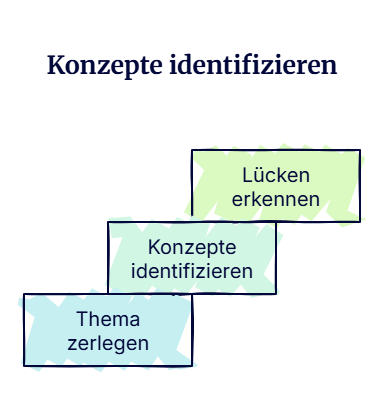
The first step is to break this topic down into its individual parts. I call them concepts—that is, the central terms contained in your topic.
In our example, these would be: autism as one concept, support as another, and lower secondary education (more precisely: a Viennese middle school) as a contextual variable.
That may sound trivial, but it isn’t. As soon as you have your concepts clearly laid out in front of you, you suddenly see where the gaps are. And that is exactly what the next step is about.
Good to know: You do not have to be able to define every word perfectly. What matters is that you identify the main components of your topic and consciously distinguish them from one another. The fine-tuning comes later.
Step 2: What is missing?
Now things get exciting. Take a look at your concepts and ask yourself: What is actually missing here, but would be important?
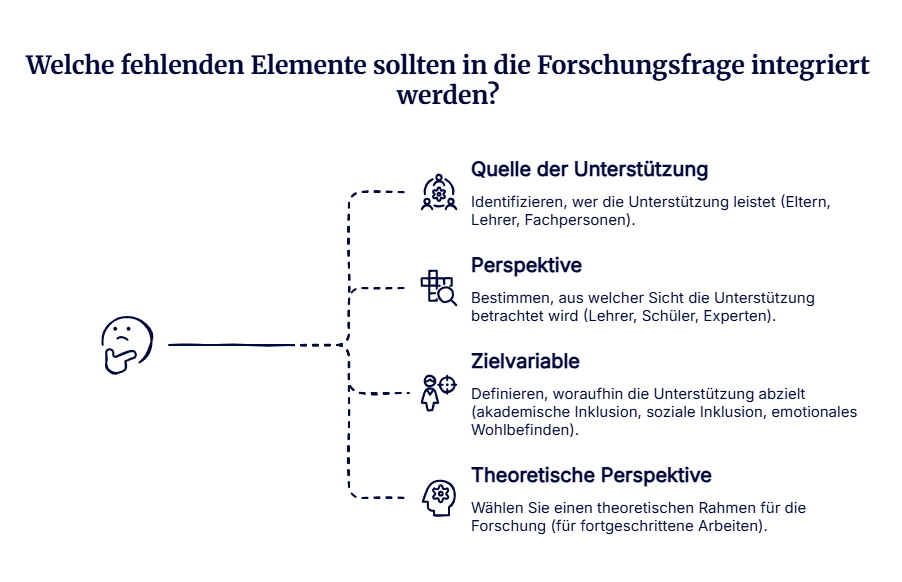
For example, the example above does not include the question: Who is providing the support? Are we talking about parents? Teachers? Professionals from outside the school? When we talk about the school context, we probably mean teachers — but this is not stated explicitly anywhere. So let’s add it.
Another thing that is missing is a perspective. Even if it is clear that teachers support students — from whose perspective are we looking at this? From the perspective of the teachers providing the support? From the perspective of the students experiencing it? From the perspective of experts assessing it from the outside? Each of these perspectives leads to a fundamentally different research question.
And then there is the question of the outcome variable. Support — toward what end? Are we talking about academic inclusion? Social inclusion? Emotional well-being? Even within the area of inclusion, there are so many different aspects that you need to make a deliberate decision here.
For more advanced projects — such as Bachelor’s or Master’s theses — a theoretical perspective is often added. In other words: Which theory am I using to examine my research project? This makes the question even more precise and gives your work a clear analytical lens.
Our tip: Write down all the concepts — including the missing ones. Put them next to one another. You’ll notice that simply having this overview almost makes the direction of your research question emerge on its own.
Step 3: Generalizing and Specifying
Now we come to the step that gives you real flexibility — and that most students never take.
Take each of your concepts and consider: How could I frame it more broadly? And how could I frame it more narrowly?
Let’s stay with autism. If you generalize, you end up with neurodivergence — that is, any form of neurodivergent thinking, not just autism. If you make it more specific, you could focus on a particular area within the autism spectrum, such as people with a specific diagnosis.
The same applies to the context. You could broaden lower secondary education to include both lower and upper secondary education, or include primary school as well. Or you could narrow it down: just the first and second grades of a Viennese middle school. Or just girls — especially in autism, this is an area where the research gap is particularly large.
You can play this game with any concept. Outcome variable, perspective, actors — everything can be moved in both directions.
But why should you do that?
Why the effort is worthwhile
Research is never linear. It is iterative — you move forward, encounter limits, go back, make adjustments, and move forward again. This is not a sign of poor planning. It is the norm.
And that is precisely why it is so valuable to think through alternatives for your research question early on. Because when you realize in the field that you cannot reach your original target group or that the data look different than expected, you need fallback options. And you only have those if you have systematically considered in advance where you can generalize or become more specific.
For practice-based research projects conducted in groups, this may not always be absolutely necessary—you receive ongoing feedback and are guided anyway. But for theses, it is absolutely crucial. The earlier you have a topic and a tentative research question, the more purposefully you can work. And if you know that you have alternatives up your sleeve, you can move forward with genuine confidence.
The goal is not to have the perfect question from the outset. The goal is to have a good question that you can consciously continue to develop.