
LinkedIn is full of posts celebrating the PhD as the ultimate proof of expertise.
And it is easy to see why that narrative is appealing — especially after years of demanding, often isolating research work.
But there is a problem with it.
Treating your PhD as proof of expertise can actually work against you — in the job market, in your academic development, and in the way you approach what comes next.
In this post, I want to offer a more honest framing of what a PhD actually prepares you for, why the expert narrative falls short, and what mindset will serve you better as you navigate PhD jobs, academic positions, and the broader job market after your doctorate.
Finishing your PhD does not make you an expert — and that is good news.
There is a narrative circulating on LinkedIn that goes something like this: the moment you complete your PhD, you become an expert.
You have mastered your field. You are ready.
It is a motivating thought. It is also, for the most part, not true.
And believing it too firmly may actually slow down your development — professionally, academically, and personally.
What the Job Market Actually Rewards
When you enter the job market with a PhD, institutions and employers are not primarily looking for someone who has mastered a niche topic.
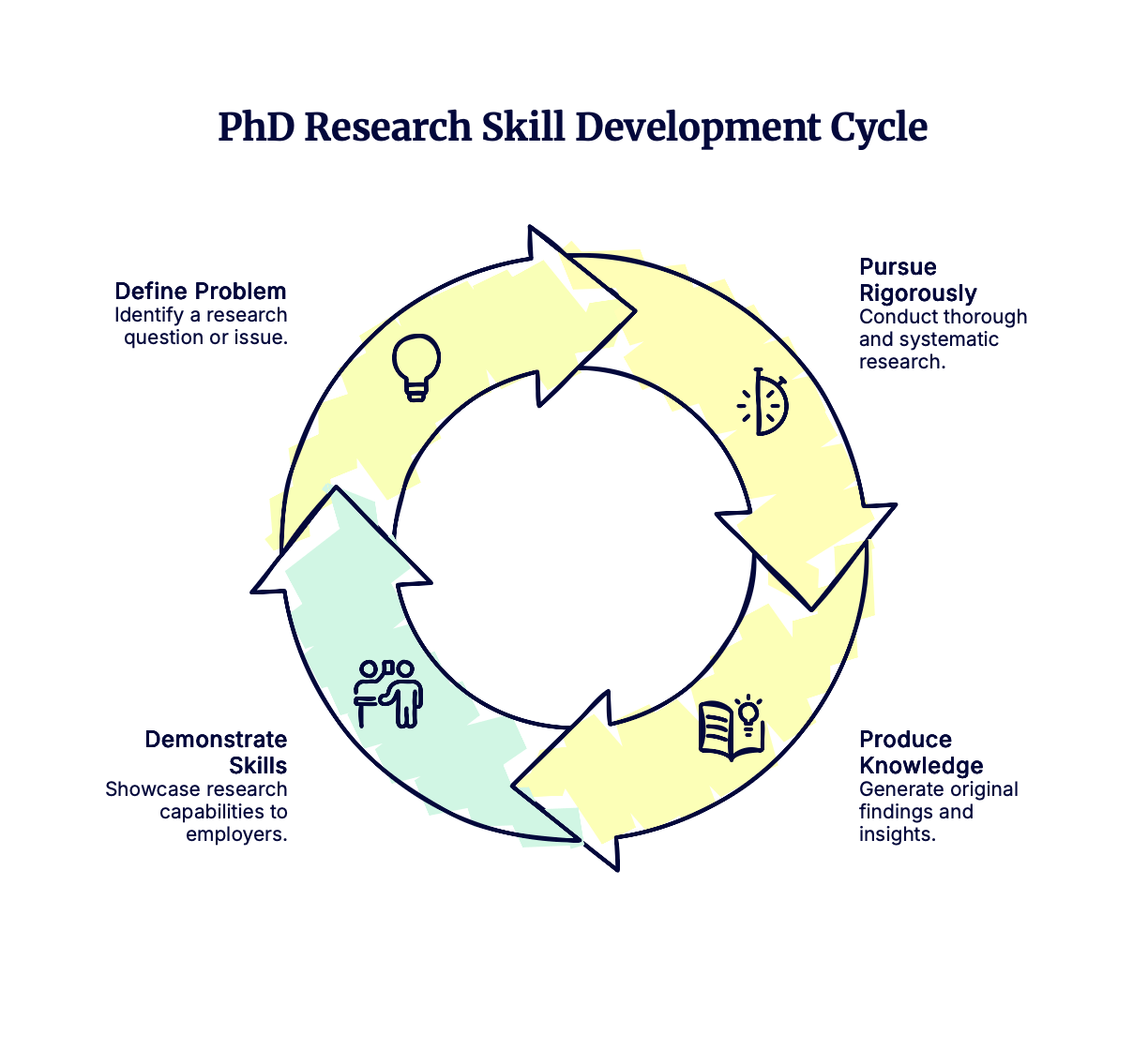
They are looking for someone who has demonstrated the ability to conduct independent research.
That is what a PhD certifies.
Not expertise in a broad sense. Not readiness for every academic position. But the capacity to define a problem, pursue it rigorously, and produce original knowledge — on your own.
That is a significant and rare skill. But it is a different claim than expertise.
Understanding this distinction matters enormously when navigating PhD jobs and deciding how to position yourself after your doctorate.
The Niche Problem: Why Your PhD Topic Alone Is Not Enough
Here is the uncomfortable truth about doctoral research: the more it niches down, the less immediately useful it tends to be.
This is not a flaw in your work. It is simply how research operates.
A highly specific finding answers a highly specific question. Valuable within academia — but rarely useful beyond it without something else added.
Think of it this way.
A graphic designer who specialises exclusively in the colour blue has a technically defensible specialisation. But it is not useful to anyone until it connects to something larger.
Perhaps they notice that lawyers are drawn to blue for what it communicates about trust and authority. They begin working with law firms. They learn about brand identity, professional credibility, and what that client base actually needs.
The colour blue did not make them an expert. The combination did.
Your PhD niche works the same way.
It becomes genuinely useful — in the academic job market or beyond — once it is combined with other perspectives, other fields, other contexts.
The Expert Myth and Why It Persists
Part of it is LinkedIn culture, where credentials are currency and every completed milestone becomes a professional identity claim.
A finished PhD follows the same logic — it becomes a badge, a shorthand, a signal.
As a motivational framing, it has some value. Completing a doctorate is a serious intellectual achievement.
But motivation and accuracy are different things.
Telling yourself you are an expert when you are not does not accelerate your development. It stalls it.
The most important obstacle to continued learning is an inflated sense of what you already know.
If you leave your PhD convinced you have arrived, you close yourself off to precisely the kind of growth that makes your knowledge genuinely useful — in jobs after PhD, in academic positions, and in the broader world.
The Beginner’s Mindset as a Career Advantage
There is a concept in Zen philosophy called shoshin — beginner’s mind.
The expert’s mind has few possibilities. The beginner’s mind has many.
For researchers navigating the job market after a PhD, this is not just philosophy. It is strategy. Approaching your post-doctoral career with a beginner’s mindset means staying curious about adjacent fields.
It means remaining open to how your research skills apply in contexts you did not train for. It means resisting the urge to over-specialise your identity before you have explored what combination of knowledge actually creates value.
This openness is what allows cross-niche connections that make expertise real rather than nominal.
It is also what makes you genuinely competitive — whether you are applying for academic positions, exploring PhD jobs in industry, or considering paths that did not exist when you started your doctorate.
What a PhD Actually Gives You
Let me be direct about what you do have when you finish your doctorate.
You have proven you can work independently on a complex, open-ended problem.
You have developed rigour, precision, and the ability to sit with uncertainty long enough to produce something original. Those are not small things.
They are exactly what makes PhD graduates valuable — not just in traditional academic positions, but across the full landscape of PhD jobs and careers after a doctorate.
What you do not yet have is the combination.
The cross-disciplinary connections. The applied experience. The contextual knowledge that turns a narrow specialisation into something broadly useful.
That part comes next. And it comes faster when you approach it as a beginner.
Stay a Beginner
The researchers who build genuinely meaningful careers after their PhD are rarely the ones who entered the job market convinced they had already arrived.
They are the ones who treated their doctorate as a starting point.
They combined their niche with other lenses. They stayed curious. They were willing to be wrong, to learn, and to keep developing.
You have shown you can do research on your own. That is real, and it matters.
Now the work of building something useful with it begins.