
Academia is competitive by design. There are more qualified researchers than there are permanent positions, and the pressure to move fast, publish more, and secure the next role can feel relentless.
Most PhD candidates and postdocs respond to that pressure by treating every year without a professorship as a year falling behind.
But there is a quieter, more sustainable strategy that rarely gets discussed openly. It does not require you to outperform everyone around you. It does not demand sacrificing your wellbeing for a distant goal. It simply asks you to think in longer timeframes than most of your peers are willing to.
In this post, I want to make the case for playing for time — what it means, why it works, and how to build the kind of academic position that makes it possible.
Most academics lose the university professorship race by running it too fast.
There is a quiet truth about academic careers that few people say out loud: the researchers who eventually reach a full professorship are often not the most brilliant ones. They are the ones who stayed.
This is not a cynical observation. It is a structural reality — and once you understand it, it changes how you think about your educational career goals entirely.
Why There Are More Postdocs Than University Professorships and What That Means for You
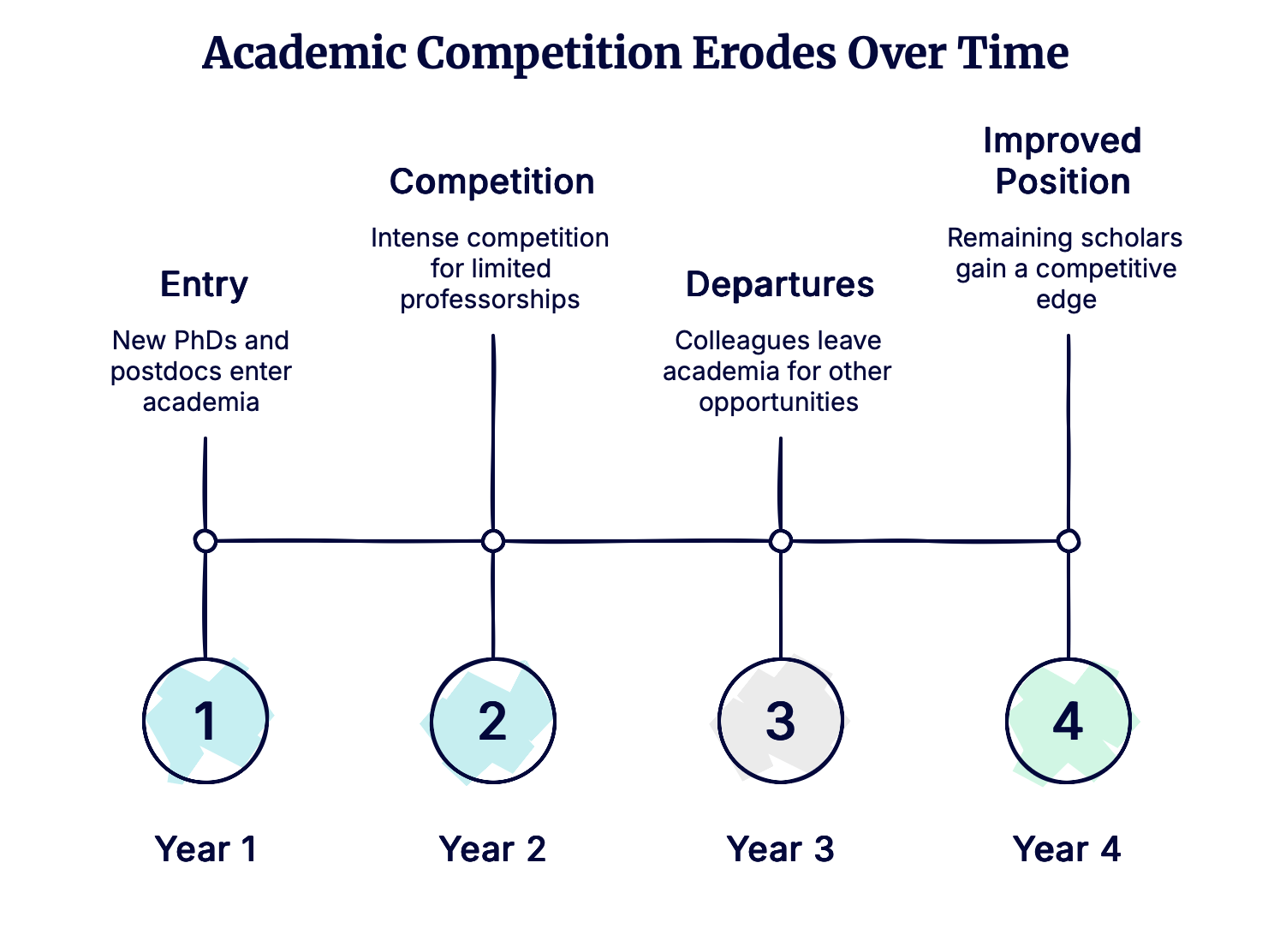
Academia produces far more PhDs and postdocs than there are professorships available. This is not a secret. Most people in your position know this. What fewer people recognize is what this imbalance actually means for your strategy.
It means your competition erodes over time.
With every passing year, colleagues leave academia — for industry, for other sectors, for personal reasons. Some burn out. Some grow impatient. Some simply decide the uncertainty is no longer worth it.
Each departure quietly improves your position — not because you did anything exceptional, but because you remained.
This is the core of what I call playing for time.
Playing for Time: A Deliberate Academic Career Strategy
Let me be precise here, because this distinction matters enormously.
Playing for time does not mean sitting still, hoping a university professorship will eventually fall into your lap. It means deliberately building a position — a role, a rhythm, a professional life — that you can sustain indefinitely without burning out or losing your sense of purpose.
The question to ask yourself is not: “How do I get to the next step as fast as possible?”
The better question is: “Could I live well in my current position for the next five to ten years, and still say yes to an opportunity if it appears?”
If the answer is yes, you are already playing the long game correctly.
What a Sustainable Academic Position Actually Looks Like
Not every postdoc or interim position qualifies as a viable long-term base. A position worth playing for time in has a few key characteristics:
It gives you enough stability to plan your work and your life without constant existential anxiety. This does not require a permanent contract — but it does require a degree of predictability.
It allows you to do work you find genuinely meaningful.
If you are enduring your current role rather than engaging with it, you will not last long enough for the strategy to work. The researchers who reach a full professorship after a long trajectory are typically those who found ways to genuinely invest in their work along the way.
It keeps you inside the academic ecosystem.
Whether that means teaching, publishing, supervising, or serving on committees — you need continued visibility and contribution. Proximity to the system matters when opportunities arise.
An honorary professorship, for instance, can sometimes serve this function: it maintains academic identity and institutional connection without requiring a full-time position.
It is not the endgame, but it is not nothing either.
The Biggest Mistake Researchers Make When Pursuing a Full Professorship
The most common mistake I see among ambitious researchers is what I would call premature urgency — the feeling that if you have not secured a university professorshipby a certain age or career stage, you have somehow failed.
This feeling is understandable. Fixed-term contracts, social comparisons, and the general anxiety of academic life all fuel it.
But acting on it tends to produce poor decisions: applying for positions you are not ready for, accepting roles that drain rather than sustain you, or leaving academia prematurely out of frustration.
Your educational career goals do not need a fixed deadline. They need a direction, a sustainable base, and the patience to let the structural dynamics of academia work in your favor.
Why Patience Is the Most Underrated Path to a University Professorship
I want to be honest with you: this is, in some ways, a deliberately lazy strategy.
It does not promise a dramatic transformation or a fast track to a full professorship. It asks you instead to invest in your own sustainability — to find a position you genuinely want to be in, and to stay there with intention.
What makes it powerful is precisely what makes it uncomfortable for high-achieving researchers: it requires you to release the urgency.
If you can build a professional life in which you are contributing meaningfully, developing your expertise, and remaining connected to the academic world — and if you can do this without constantly looking over your shoulder at the next milestone — you are in a stronger position than most of your peers.
Not because you are smarter. Not because you applied to more positions.
Because you are still there.