
If you’re building an academic career, you’re also building a network—whether you like it or not.
Not a network in the LinkedIn sense. A real network: the people who co-author with you, invite you, recommend you, review you fairly, warn you quietly, or decide you’re not worth the risk.
This article is about academic networking as relationship management: choosing collaborators wisely, protecting trust once earned, and avoiding small social missteps that can cost years.
Academic Networking Is Not “Extra” Work. It Is the Work
Many early-career researchers treat networking as a separate task: attend events, meet people, exchange emails.
In reality, your network is created in the daily details of collaboration:
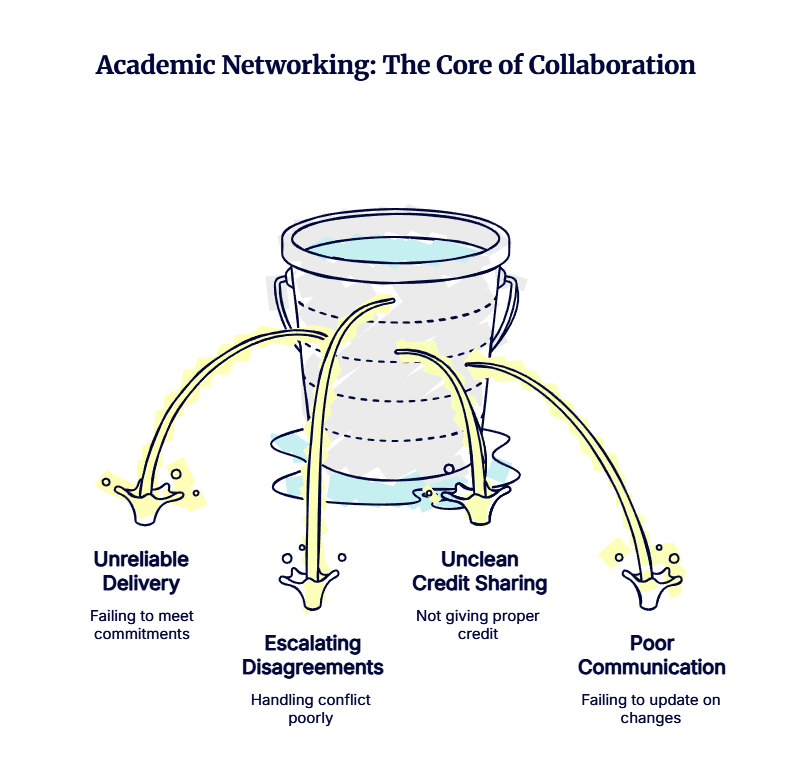
- Do you deliver when you say you will?
- Do you handle disagreement without escalating it?
- Do you share credit cleanly?
- Do you communicate clearly when things change?
You don’t build trust in one big moment. You build it through repeatable behaviour.
The Hidden Constraint: You Can’t Maintain Unlimited Relationships
A quiet problem many PhD candidates and postdocs don’t name: social bandwidth. You can start many collaborations, but you cannot maintain all with the same quality.
Overload leads to:
- Overpromising
- Disappearing
- Delayed difficult conversations
- Rushed work
And overload doesn’t just harm productivity—it harms trust.
Trust Is the Currency That Keeps Your Academic Career Stable
In academia, trust is practical. It determines whether people:
Trust is cumulative. It’s not a feeling, but a prediction: “I believe you will behave reliably and fairly.”
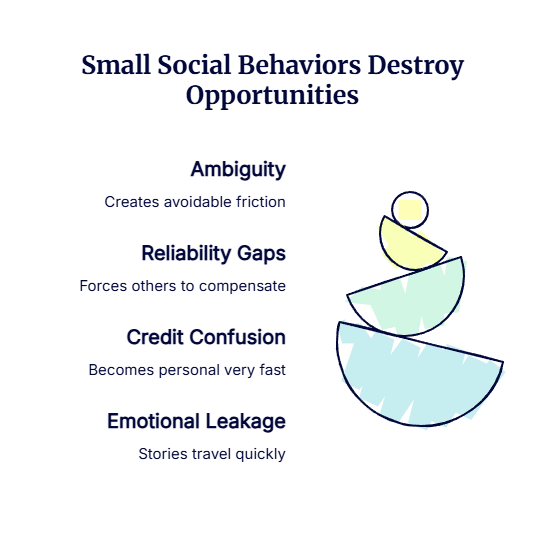
The Small Social Behaviours That Quietly Destroy Opportunities
Career damage often comes from repeated minor behaviours, not dramatic conflict:
1) Ambiguity that creates avoidable friction
You meant well. But you didn’t clarify roles, timelines, authorship expectations, or decision rights.
Then the project becomes a guessing game. And guessing games create resentment.
Fix: put agreements into writing early, even if it’s informal. One email can prevent months of tension.
2) Reliability gaps that force others to compensate
Late drafts. Missed meetings. Slow replies. Silent weeks.
Individually, these seem harmless. Collectively, they signal: “You are risky.”
Fix: be conservative with commitments. Underpromise. Deliver. Communicate early when you can’t.
3) Credit confusion
A collaborator feels their contribution wasn’t acknowledged. Or you feel you’re doing most of the work without recognition.
Credit issues rarely stay technical. They become personal fast.
Fix: treat authorship and contribution statements as relationship hygiene. Discuss them before emotions enter the room.
4) Emotional leakage under stress
You vent to the wrong person. You forward an email you shouldn’t. You “joke” in a way that lands poorly.
Academia is smaller than it looks. Stories travel.
Fix: build a habit: when you’re stressed, pause before you write. Draft. Wait. Send later—or not at all.
A Practical Framework for Trust-Based Academic Networking
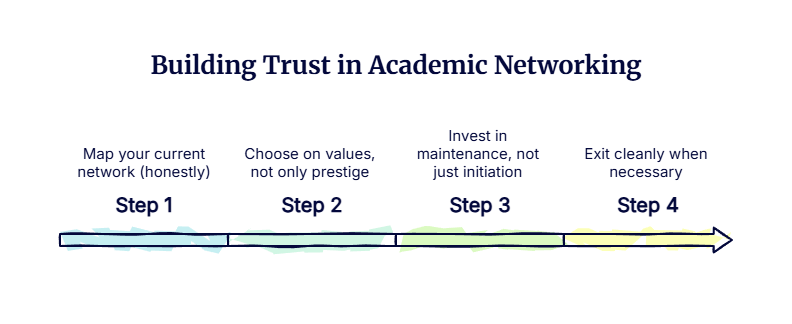
Here’s a simple way to think about your collaborator network as part of your academic career.
Step 1: Map your current network (honestly)
List your key relationships in three circles:
This isn’t about judgement. It’s about clarity.
If your core circle is too large, you’ll feel it: constant maintenance, constant catching up, constant low-grade anxiety.
Step 2: Choose on values, not only prestige
Prestige matters. But it’s not the whole story.
Ask value-based questions:
You’re not just choosing a project. You’re choosing a relational environment you’ll spend months inside.
Step 3: Invest in maintenance, not just initiation
Most researchers are good at starting collaborations. Fewer are good at maintaining them.
Maintenance looks unglamorous, but it’s where trust quietly accumulates.
Step 4: Exit cleanly when necessary
Sometimes a collaboration isn’t working. Dragging it out like ghosting, delaying, avoiding often causes more damage than ending it.
A clean exit is calm, specific, and respectful:
Leaving well is part of academic networking.
Closing Thought: The point is not to be liked. The point is to be trustworthy.
A stable academic career is not built only on publications and grants. It’s built on people’s willingness to work with you again.
You don’t need a large network. You need a coherent, high-trust network that fits your bandwidth and reflects your values.
Choose fewer collaborations. Maintain them well. Protect trust with boring consistency. That’s not “soft.” That’s career infrastructure.
Frequently Asked Questions (FAQs)
It means treating your professional network as relationship management, not visibility management: the daily behaviours that make others experience you as reliable, fair, and easy to collaborate with.
Because in academia, trust is practical currency: it determines whether people share early ideas, include you on grants, invite you into consortia, recommend you for roles, and give you the benefit of the doubt when something goes wrong.
Fewer than you think. The bottleneck is social bandwidth: you can start many collaborations, but you can’t maintain unlimited relationships with consistent quality. Overload leads to delays, avoidance, and rushed work—which damages trust.
Use the commitment test: Can I maintain this relationship well for the next 6–18 months? If not, the “opportunity” may become a reputational risk.
Treat authorship as relationship hygiene: discuss it early (before emotions enter the room), and keep contribution expectations explicit. If it feels awkward, that’s usually a sign it’s important.
Use the commitment test: Can I maintain this relationship well for the next 6–18 months? If not, the “opportunity” may become a reputational risk.