
If you are a PhD candidate or postdoc, a large part of your working day is spent surrounded by text. Articles, manuscripts, reviewer reports, emails, student work. In many ways, your job is reading and writing.
And yet, many researchers carry the same quiet thought: other people seem to read more, know more, and stay ahead of the conversation.
Instead of asking you to work longer hours, it looks at reading as a deliberate practice that supports academic productivity over years, not weeks.
When reading is treated as real work and given a protected place in your day, it becomes a quiet but powerful advantage for your thinking, writing, and career decisions.
What Warren Buffett and James Clear Understand About Knowledge Accumulation
There is a well-known story about Warren Buffett being asked how to prepare for a career in investing. Students expected advice about models or tools.
Instead, he said: read.
Buffett has repeatedly compared knowledge to compound interest. You build understanding slowly, but once it accumulates, it becomes hard to catch up with if others are not doing the same. Reportedly, he spent much of his working time reading and thinking.
James Clear translated this principle into a simple habit. He realised that most of his reading was reactive. He clicked what appeared on his screen. Algorithms decided what he read.
Books were constantly pushed aside.
To change this, he introduced one rule: read 20 pages at the start of the day. After waking up, he opened a book and read. Twenty pages. Every morning.
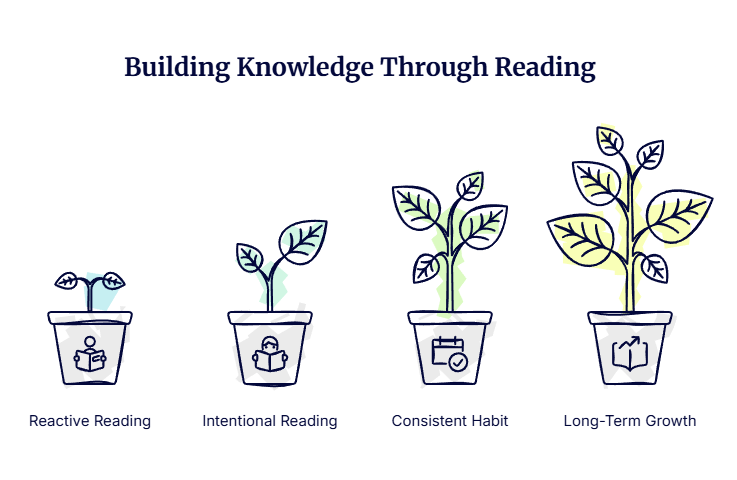
The Quiet Routine Behind Academic Expertise
For academia, the exact numbers are less important than the principle.
There is visible academic work: papers, grants, talks, teaching.
And there is capacity-building work: the activities that shape how well you can do these things over time.
Deep, continuous reading belongs to the second category.
It rarely feels urgent. No deadline explodes if you skip it. That is why it is so easy to postpone.
And that is exactly why it matters.
Reading as a Driver of Academic Productivity
Academic productivity is usually measured by outputs. Publications. Projects. Conferences.
All of this matters. But underneath sits something slower and harder to measure: the quality of your understanding.
Regular, intentional reading strengthens this foundation.
When you read beyond what you immediately “need”, patterns start to emerge. You notice recurring arguments. You recognise familiar methods under new labels. You see limits more clearly.
This has very practical effects on academic productivity:
Instead of constantly catching up, you slowly gain overview.
The main obstacle is not motivation, but urgency. There is always another email, task, or meeting. This is why a small, protected reading habit can make such a difference.
Turning reading into visible progress
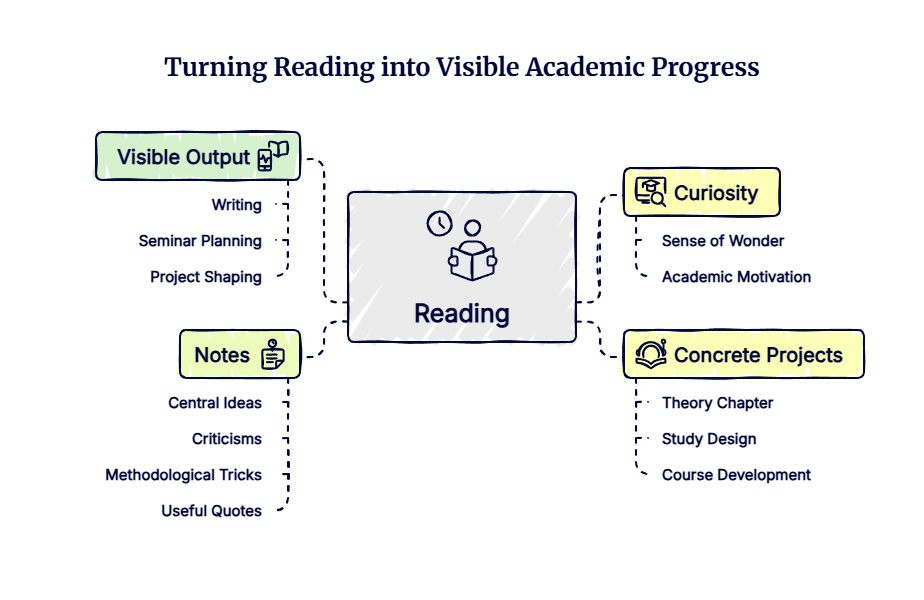
Reading for its own sake already has value. It restores curiosity.
If you want your reading habit to support academic productivity more directly, connect it to concrete projects.
Keep a short list of texts that matter most right now. After each session, jot down a few sentences: a core idea, a criticism, a useful quote.
These notes do not need to be polished. Their role is simple: to prevent reading from dissolving into vague impressions.
Over time, this creates a bridge between quiet reading and visible output. When you write, teach, or design a project, material is already there.
Reading as a long-term strategy
An academic career is not only about building a CV. It is about building a life that feels intellectually sustainable.
That life looks very different depending on whether you constantly feel underprepared, or steadily deepen your understanding of your field.
Treating reading as a non-negotiable part of your workday helps move toward the second version. You do not need marathon sessions or complex systems.
A protected half hour is enough.
The most important shifts in academic productivity are often quiet.
More clarity. More confidence. More courage in your thinking and writing.
Reading, done consistently, supports all of these.
Start small. Stay kind to yourself. This is not about winning a reading contest. It is about building an intellectual life that can carry you through the many years an academic career can span.
Conclusion
Academic productivity is rarely transformed by dramatic changes. It grows through small, well-placed routines that quietly strengthen your thinking over time.
Treating reading as intentional work, rather than something you fit in when time allows, helps you build clarity, confidence, and intellectual stability.
Twenty protected pages a day are enough to shift how you write, decide, and position yourself in your field.
This is not about reading more than others. It is about creating the conditions for sustained academic work. Start small, stay consistent, and let reading do what it does best: support the kind of academic life that is built to last.
Good luck!