
Your tool may be brilliant—but without a funding model, it quietly disappears.
Many researchers develop practical tools from their PhD or postdoc work. You have findings, a target group, and the urge to make it useful for practitioners. But this is often where projects stall.
Staying in research mode, avoiding questions about money, and hoping the project survives on idealism and overtime is common—but it’s also fragile.
This article is about the uncomfortable but necessary shift: treating your project as academic entrepreneurship—not “selling out,” but ensuring your work can actually last.
Why your PhD tool is not “just another study”
As researchers, we are trained for a specific logic: clarify the question, review the
As researchers, we are trained to: clarify the question, review literature, design methods, collect and analyze data, publish. This mindset is powerful—but it does not map to building a living, practical tool.
A tool needs:
Treating it like a study leads to:
At some point, implementation requires a different mindset and toolkit: entrepreneurial resources, product design concepts, and simple business thinking.
This is still research-driven — but no longer research-only.
Academic Entrepreneurship as Responsibility, Not Hype
“Academic entrepreneurship” can feel alien. Pitch events, investors, and profit-driven startup culture may come to mind.
Here, it’s grounded and practical:
- You built something based on research
- It genuinely helps a practitioner group
- You want it to exist beyond your contract or grant
For that, your project must carry itself. It cannot indefinitely rely on unpaid work or uncertain third-party funding.
Thinking about money and a simple funding model is responsible, not greedy. It ensures your work survives and continues to have impact.
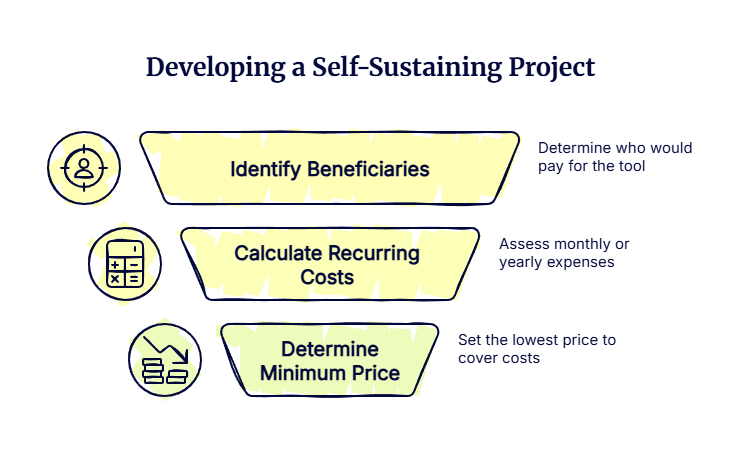
Your Project Needs to Pay Its Own Bills
Concretely, a successful tool requires:
In academia, we rely on hidden subsidies: unpaid overtime, temporary assistants, cross-subsidized grants. For a long-term tool, this breaks.
A basic funding model answers questions like:
You are not building a unicorn startup. You are creating a self-sustaining structure for your research tool.
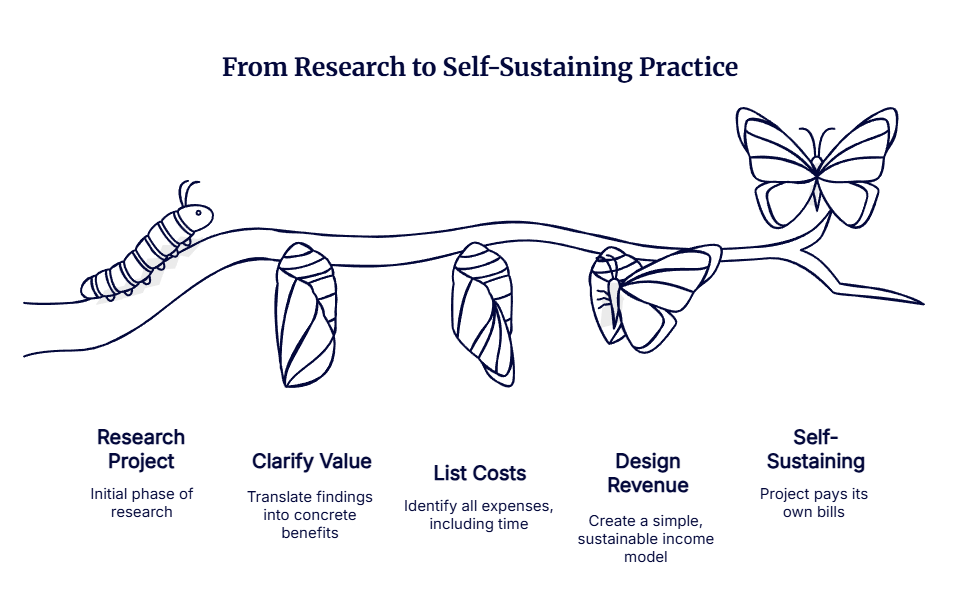
From Research Project to Self-Sustaining Structure
1) Clarify the Value – in Practitioner Language
Translate findings into concrete benefits:
- “You save two hours per week on…”
- “You avoid costly mistakes in…”
- “You get a clearer overview of…”
This is classic research-to-practice work, with a focus on practical impact.
2) List Your Real Costs
Make a simple list of all costs:
- Tools, software, hosting
- Your time (with an hourly rate)
- Collaborators’ time
- External services
Seeing real costs highlights why “just do it next to the day job” rarely works.
3) Design the Lightest Possible Revenue Model
Ask: “What is the smallest, least bureaucratic way this can earn money?”
Examples:
- Small subscription fee per practitioner
- Institutional licenses for departments or schools
- Paid workshops that include access
- Consulting or training packages built around the tool
Goal: the project pays its own bills, not maximizing profit.
Staying Aligned With Your Values While Talking About Money
Many fear charging for a tool compromises integrity.
Instead, let your values guide your funding model:
Academic entrepreneurship does not mean abandoning your academic identity. It extends your responsibility from producing knowledge to sustaining its impact.
Bringing It All Together: A New Mental Model
If you are a PhD or postdoc with a research-based tool:
- You don’t need to become a full-time founder
- You do need a new mental model
Your project is no longer “just research.” It is a structure that must stand on its own.
Thoughtful work on money, time, and sustainability is part of your impact. Your research gave you the content; academic entrepreneurship gives you the container for that content to live independently.
If your work is to matter in practice, this step is non-optional: How do you build it to last?