
Reading Clubs, Writing Retreats, and Why Academic Collaboration Needs to Go Beyond Conferences
There’s a version of academic community that most of us know well. You submit an abstract, wait six months, travel somewhere, present your work for twenty minutes, attend a few panels, have some hallway conversations you mean to follow up on, and then go home. Two years later, you do it again.
This model has real value. But it has a structural problem: the collaboration is episodic. Community forms in concentrated bursts and then disperses. For researchers who spend the rest of their time working in isolation — particularly doctoral students and early career researchers — the gap between those bursts is long, and it can be punishing.
A different model is gaining ground, and it’s worth paying attention to.
The isolation problem is bigger than we admit
Across OECD countries, attrition rates at the doctoral level approach 50%. The reasons are multiple, but a consistent thread is the isolation that sets in once coursework ends. Daily contact with peers drops sharply. Supervision becomes sporadic. And the task that remains — writing — is the hardest one, the one that takes longest, and the one that academic programs almost never teach explicitly.
Researchers are expected to produce complex written work at a high level without having been systematically trained to do it, and without the structural support that makes sustained effort possible. The result is a well-documented cycle: writing feels overwhelming, avoidance kicks in, stress builds, progress stalls.
This isn’t a personal failing but design failure.
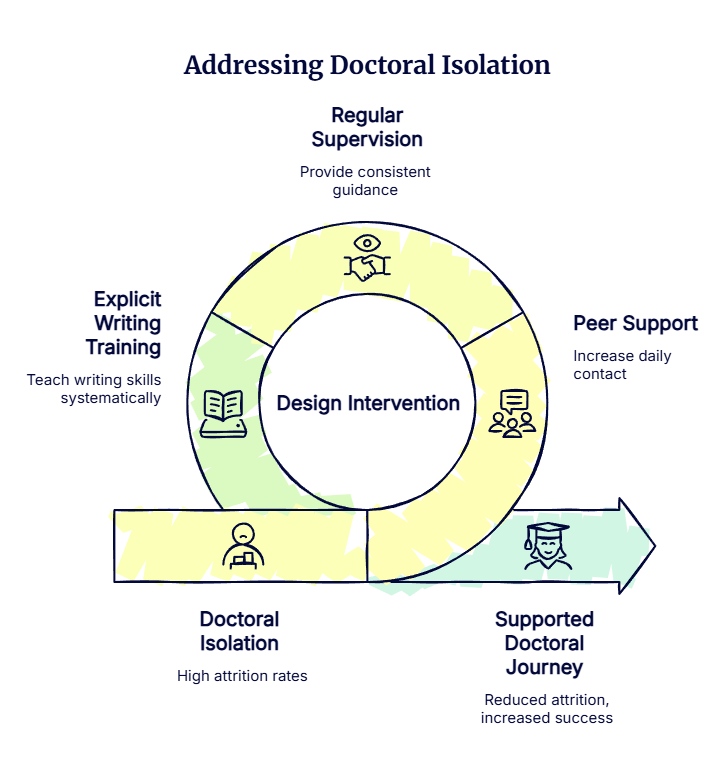
Writing retreats and what collective practice actually does
The response that’s been developing over the past decade or so — in Quebec, Scotland, Switzerland, the Netherlands, Nigeria, and elsewhere — is structured collective writing. Not workshops. Not seminars. Actually sitting down to write together, with other people, in shared time.
The research on these practices is increasingly clear. Participants report higher productivity, better writing habits, reduced psychological distress, and crucially, a stronger sense that their writing time is legitimate. That last one matters more than it might sound. In a culture dominated by the publish-or-perish imperative, finding time to write can feel self-indulgent unless it’s institutionally sanctioned. Writing retreats and writing groups provide that sanction. They make the time real.
The mechanisms behind this aren’t mysterious. Goal-setting, time management, structured breaks — none of these are new ideas. What changes is the context: doing them collectively, in an environment that fosters belonging, produces results that are genuinely hard to replicate alone at a kitchen table.
Reading clubs as the other half of the equation
Writing retreats address the production side of research. Reading clubs address something equally important: the deep, critical engagement with literature that underlies good scholarly work.
A well-run reading club isn’t a passive activity. It builds the analytical and critical appraisal skills that writing depends on. It creates shared vocabulary. It models what published work actually looks like at a granular level — how arguments are constructed, how theory is deployed, how gaps in the literature are identified and filled. These are skills that supervision alone often can’t develop systematically, particularly when supervisors are stretched and contact is infrequent.
But the most underrated function of a reading club is continuity. When researchers ask what distinguishes this kind of ongoing engagement from a one-off training session, the answer is sustained presence. As one participant put it, the difference is between learning about something in a workshop and growing through repeated engagement over time. The community is the point, not just the content.
Crossing borders is the natural next step
Both of these practices — writing retreats and reading clubs — started as local or institutional initiatives. But there’s no particular reason they need to stay that way.
The barriers that once made cross-border academic collaboration cumbersome — time zones, costs, logistics — have mostly collapsed. An online writing session works. A virtual reading club works. And when you remove the geographic constraint, you can build something the conference model structurally cannot: a community that includes researchers from institutions that don’t have the resources to send people to European conferences every two years, that includes early career scholars from contexts where English-language publishing is already a significant disadvantage, that doesn’t require travel budgets or institutional sign-off.
What you get, if you build it well, is a community of practice that spans career stages and geographies — where senior researchers contribute critical scaffolding, early career researchers build confidence and analytical skill, and everyone benefits from the diversity of perspective that a single-institution group can never offer.
The sustained engagement gap
There’s a pattern worth naming here. The activities that researchers consistently report as most valuable for their development are the ones that don’t fit neatly into a conference schedule: informal writing sessions with colleagues, long-running reading groups, collaborative projects that unfold over months. Yet these are exactly the activities that institutions rarely fund, rarely count toward workload, and rarely build infrastructure to support.
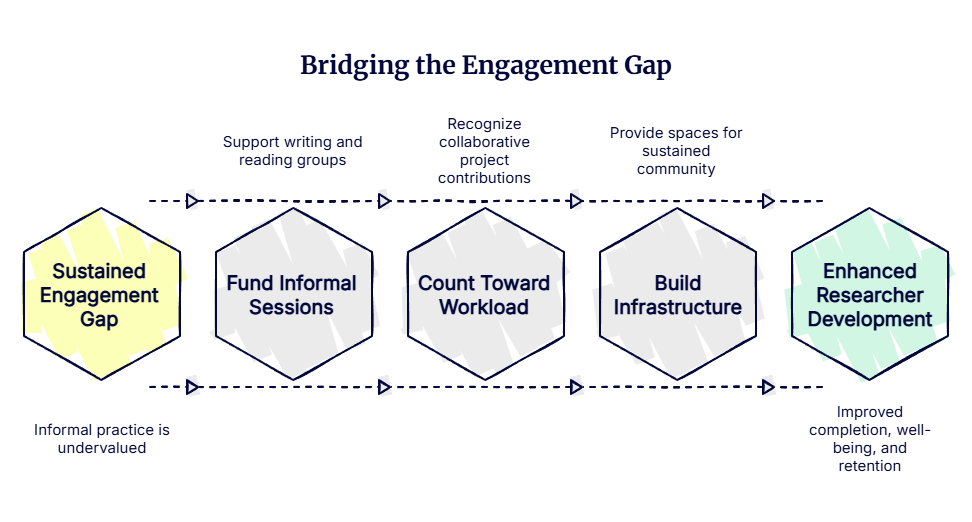
The argument for investing in collective practice isn’t soft. The data on doctoral completion, on researcher well-being, on the relationship between isolation and attrition — it points in one direction. Structured community isn’t a nice-to-have. For many researchers, particularly those early in their careers, it’s the difference between finishing and not finishing, between publishing and not publishing, between staying in academia and leaving.
Conferences matter. But they’re not enough. The work of building academic community has to happen in the spaces between them, and it has to be sustained.