
In coaching, I regularly meet researchers who arrive with a very specific target in mind. A particular PhD program. A specific institution. A professorship they have been working towards for years.
That focus is not a bad thing. But it is often where the real problem lies.
What most researchers are actually after is not the institution itself, but what it represents. Accomplishment. Belonging. Recognition.
In this post, I want to explore why academic goals are often better understood one level deeper and what changes when you make that shift.
Academic Goals and the Clarity Illusion
In coaching, I regularly meet researchers who arrive with a very specific target in mind. A particular PhD program. A specific institution. A professorship they have been working towards for years.
That focus is not a bad thing. It shows commitment and serious preparation. But knowing what you want is not the same as knowing why you want it.
Most researchers have done their homework on the what. What they have rarely examined is the why. And that gap — between target and underlying need — matters enormously for how you plan and navigate your academic career.
The Prestige Trap
When a coachee tells me they want to join a particular institution, I always ask the same question: what would that actually give you? The answers are rarely about the institution itself.
They are about the feeling of accomplishment that comes with being accepted. About belonging to something reputable — being part of a community that signals intellectual seriousness.
About external validation — the sense that years of hard work have been recognized in a way others can see and understand.
These are entirely legitimate needs. But they are not the same as academic goals. And confusing the two creates a specific kind of tunnel vision.
Academic Goals Examples: Means vs. Ends
Here is a pattern I see repeatedly in coaching.
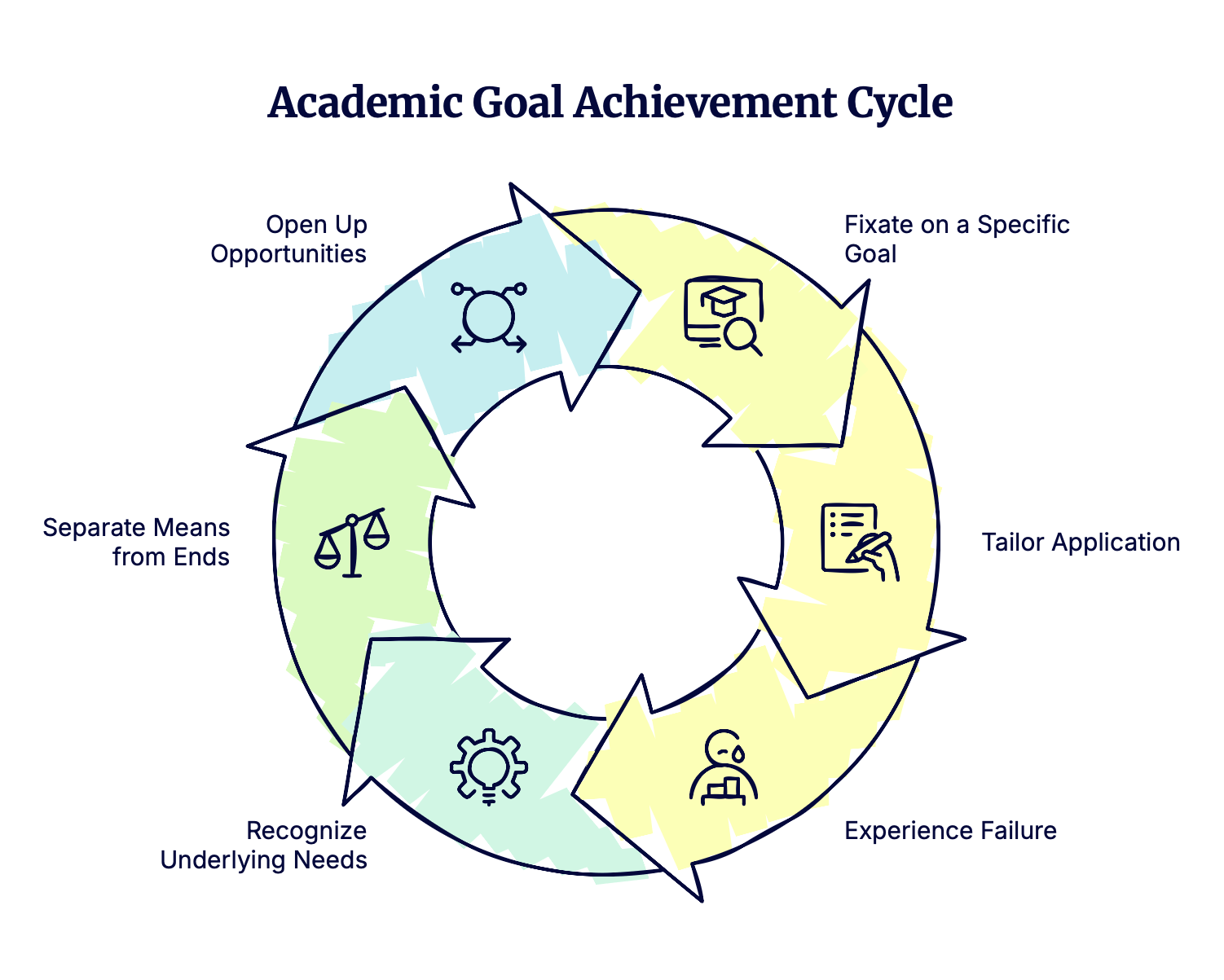
A researcher fixates on a single PhD program at a prestigious institution. They spend months tailoring their application to that one target.
If it does not work out, the failure feels total — as if the entire goal has collapsed.
But the underlying need — to do rigorous research, to belong to a serious academic community, to feel competent and recognized — has not collapsed at all.
It simply has not been separated from the specific vehicle they chose to pursue it through. This is the means-end confusion at the heart of many academic and personal goals.
The institution is a means. What it gives you is the end.
Once you see that clearly, the goal does not disappear. It opens up.
Academic Long Term Goals vs. Academic Short Term Goals
This distinction also changes how you think about timelines.
A short term academic goal might be: secure a postdoc position at institution X. A long term academic goal might be: build a research identity that is credible, sustainable, and genuinely mine.
When the short term goal is treated as the only goal, every setback becomes a crisis.
When the long term goal is kept in view, a setback in one specific application becomes what it actually is — one closed door among many possible ones.
Clarity about what you truly want creates resilience. Fixation on a single path creates fragility.
What This Means for Your Academic Career Planning
None of this means that targeting specific institutions or programs is wrong. Ambition is not the problem. Specificity is not the problem.
The problem is when a specific target becomes the only definition of success.
When that happens, you stop seeing the landscape and start seeing only one point on it.
The researchers I work with who navigate their careers most effectively are not those without clear goals. They are those who understand what their goals are actually for — and who stay flexible about the paths that lead there.
That flexibility is not a compromise. It is a strategic advantage.